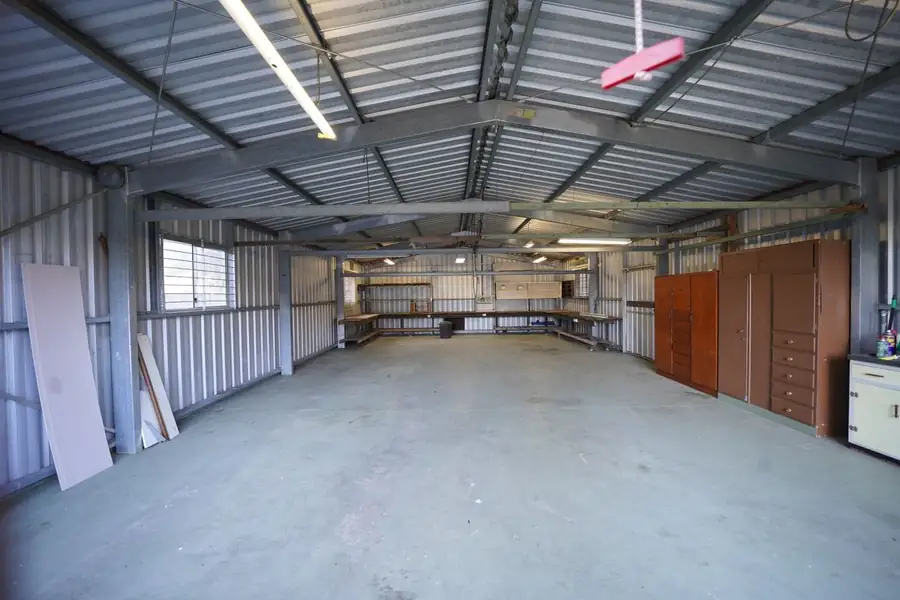
Shop floor coatings are a different job from a residential garage, and not mainly because of size. A commercial or agricultural slab has heavier point loads, a lower tolerance for downtime, a real cost attached to dust, and in this market it is almost always in a building with no heat.
The Bismarck-Mandan corridor has a lot of these buildings. Mandan alone carries BNSF division headquarters and major maintenance shops, a Marathon Petroleum refinery running 73,800 barrels a day, and the trades that support both. Add the detached pole barns on acreages across Burleigh and Morton County and unheated shop slabs are a large share of the work here.
Matching the System to the Load
| Building type | Dominant wear | System we usually specify |
|---|---|---|
| Detached hobby shop or pole barn | Dust, salt from the vehicle, dropped tools | Full flake broadcast, or densify and seal on a tight budget |
| Service bay or mechanic shop | Oil, brake fluid, jack stands, hot tyres | High-build epoxy body with a chemical-resistant urethane or polyaspartic topcoat |
| Warehouse with forklifts | Wheel abrasion in lanes and at turn points | Higher-build system, lanes and turn points detailed separately, quartz broadcast where abrasion is severe |
| Light manufacturing | Impact, chemical spill, cleanability | Quartz or flake broadcast for texture and impact tolerance, coved edges where washdown happens |
| Ag and equipment storage | Point loads, mud, chloride from the road | Penetrating sealer plus densifier, or a heavy coating in the traffic lanes only |
The Unheated Building Problem
A detached shop sits at ambient. That is the single biggest scheduling constraint on commercial floor work in this market, and it is worth being blunt about it rather than discovering it on install day.
Epoxy is best applied above 50 F and most formulations never fully cure below that. Cure time doubles for every 18 F drop below 70 F. Bismarck's cold season runs about 3.4 months with average highs under 35 F, and the frost-free window is roughly four and a half months. Take a reading with an infrared thermometer on an unheated shop slab in December and you will not like the number.
There are three workable answers. Book the job inside the warm window and plan ahead. Temper and dry the building with indirect heat and air movement, hold it through cure, and price that in honestly. Or specify polyaspartic, which cures at temperatures that stop epoxy and returns to service in hours. Polyaspartic coatings in Bismarck →
What Goes Wrong on Commercial Slabs Here
- Old curing compounds and hardeners left in the surface, which block bond and are invisible until the coating lifts
- Moisture drive on a slab poured without a vapour retarder, which blisters a film coating from underneath
- Control joints filled rigidly and then reflected as a crack through the new coating within a season
- Traffic lanes coated to the same spec as the storage areas, so the lanes wear out years early
- Coating stopped short at the overhead door, leaving a raw edge for road brine to get behind
- A winter install on an unheated slab that never reached full cure and failed at the tyres
Most of these are prep failures rather than product failures. How we prepare a slab →