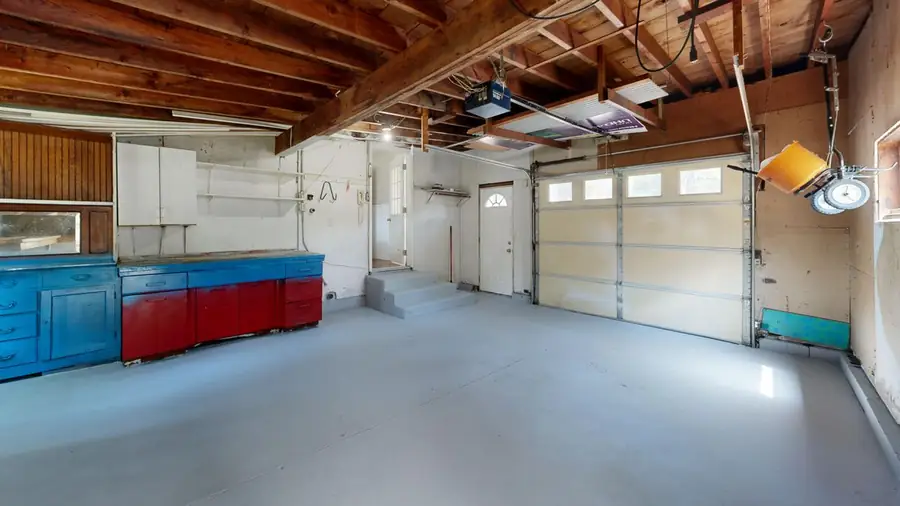
Surface preparation is roughly half the labour on a floor coating job and effectively all of the risk. A premium resin bonded to a laitance layer will fail. A mid-range resin bonded to properly ground, sound concrete will not. That is the entire argument, and it is why our quotes itemise prep rather than burying it.
Grinding to a Real Profile
When a slab is power-trowelled it develops laitance: a hard, closed skin of fine cement paste at the surface. Resin cannot key into it. Diamond grinding takes that skin off and leaves an open, measurable texture rated on the Concrete Surface Profile scale, from CSP 1 at the light-etch end up through CSP 9 for aggressive scarifying. Most residential garage coating work in Bismarck targets CSP 2 to 3.
The grinder also removes what is sitting on the slab. Curing compounds, old sealers, paraffin-based products and previous coatings all act as bond breakers, and paraffin residue embedded in the concrete is one of the recognised causes of hot tyre pickup, where a warm tyre lifts the film off in a tyre-shaped patch. Etching does not remove any of them reliably.
Everything is run under a shrouded head into a HEPA dust extractor. In an attached garage that is not a nicety, it is the difference between a clean job and silica dust through the house.
Repairing What a Bismarck Winter Has Already Taken
Deicing chlorides increase the number and severity of surface freeze-thaw events, and the damage concentrates in the drip zone inside the overhead door where slush falls off the vehicle. Scaling comes first, the loss of the finished top layer as a dusty patch and then as flakes. Spalling follows, with larger pieces breaking away and aggregate showing.
| What we find | What it means | What we do |
|---|---|---|
| Dusty, chalky surface | Weak or carbonated top layer | Grind off, then densify or prime depending on the system |
| Shallow scaling in the drip zone | Chloride-driven freeze-thaw | Grind back to sound concrete, feather the field, full flake broadcast to hide it |
| Spalls with exposed aggregate | Advanced freeze-thaw loss | Cut square edges, remove loose material, fill with polymer-modified patch |
| Hairline shrinkage cracks | Static, from the original cure | Chase, vacuum, fill with rigid epoxy or polyurea |
| Cracks that open seasonally | Moving, tied to frost depth around four feet | Flexible joint treatment, honoured through the coating rather than hidden |
| Rust rings and oil stains | Contamination into the pore structure | Grind out, degrease, spot prime; deep oil may need a moisture-tolerant primer |
Moisture: The Question Older Bismarck Slabs Force
A sheet of polyethylene under the slab is standard practice now. It was not always, and a good share of the older housing stock in central and south Bismarck, and across the river in Mandan's pre-war neighbourhoods, sits on concrete poured straight onto grade. Those slabs move moisture upward continuously.
Put a film-forming coating over an active moisture drive and the vapour has nowhere to go. It collects at the bond line, and the coating blisters or delaminates in patches that have nothing to do with traffic. The standard tests are ASTM F1869 calcium chloride and ASTM F2170 in-situ relative humidity. Where a slab is genuinely suspect the honest answer may be a breathable penetrating sealer rather than a coating at all. Staining and sealing options →
Prep is a line item, not a rounding error
If two quotes on the same Bismarck garage are far apart, prep is where the gap usually is. Ask what the profile target is, whether the old coating is being ground off or scuffed, whether spall repair is included or excluded, and whether moisture has been checked. Those four answers explain almost every price difference in this market. Cost breakdown →