Lincoln is a genuinely young town. It started as Fort Lincoln Estates, a 300 acre housing project begun in 1972 with 24 homes built by 1973, and residents voted 312 to 185 to incorporate as a city on 12 July 1977. In 1980 it had 656 people. It grew 76.9 percent in the decade to 2020 to reach 4,257, and sits around 4,365 today across just 1.551 square miles at 1,690 feet.
Practically that means almost no slab in Lincoln predates the vapour retarder era, and a large share were poured in the last twenty years. That is a different starting point from Mandan and from central Bismarck, and it changes what a floor coating job here looks like.
Young Slabs Are the Cheap Ones to Coat
On a Bismarck or Mandan floor from the 1960s, the quote usually carries three repair lines before it gets to the coating: grinding off a previous film, cutting out and patching a scaled drip zone, and treating cracks that have opened seasonally. Those lines are frequently a third of the job.
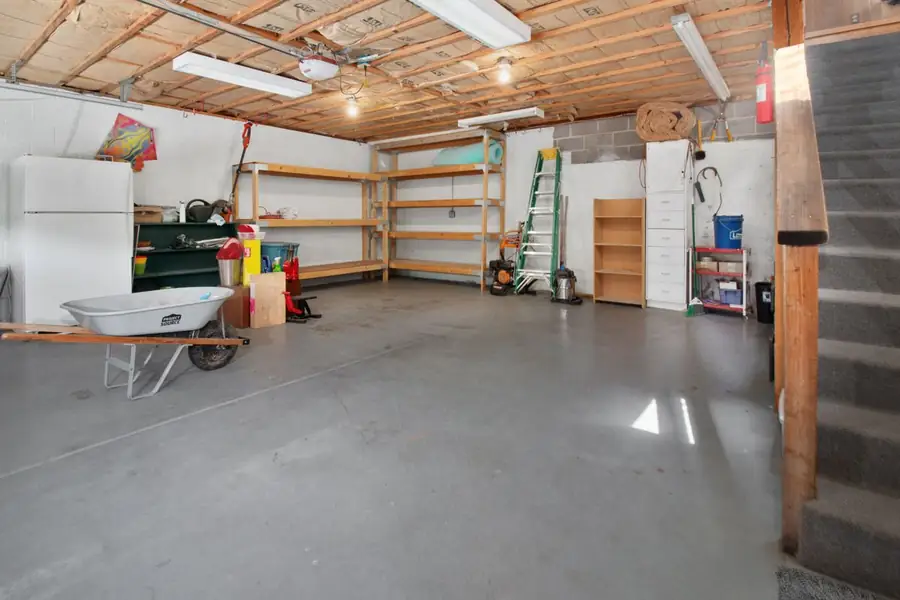
A Lincoln slab from the 2000s or 2010s typically carries none of them. The floor still has its full surface, there is no failed coating to remove, and the grinding is a clean pass to remove trowel laitance rather than a demolition exercise. The same flake system that costs a difficult old floor a premium lands at the bottom of the $6 to $12 per square foot band on a sound one.
The catch is that the window closes. Lincoln vehicles take the same NDDOT salt and beet-blended brine as everyone else in the metro, and it drips off in the same eight to ten foot band inside the overhead door. Chlorides drive repeated surface freeze-thaw there and scaling starts long before a homeowner would call it damage.
What We Watch For on a Newer Lincoln Garage
The 28 day rule
Concrete poured in the last month is not ready for a film coating. It needs roughly 28 days for the moisture drive to fall and the surface strength to develop. On a brand new build this is worth confirming rather than assuming.
Curing compound left on the surface
Production builders often spray a curing compound on a fresh slab. It is a bond breaker and it is invisible. Diamond grinding removes it, which is one of several reasons a new floor still gets fully ground.
A very hard trowelled finish
Builder slabs are usually burnished hard. That closed surface is exactly what an acid etch fails to open properly and what grinding handles reliably.
Control joint layout
Newer slabs have cleanly sawn control joints. They still move with a frost line around four feet, so they get a flexible treatment rather than a rigid fill that will crack through the coating.
Three car and RV bays
A lot of the newer stock has a deep third bay. Worth deciding early whether the whole footprint gets coated or just the parking area, because the price difference is real and the visual join has to be planned.
A note on resale
The average Lincoln home price was $306,640 as of May 2025 and the 2020 census showed a 5.4 percent vacancy rate, so this is an active, turning market. A finished garage floor is one of the few improvements that shows immediately in a walkthrough and costs a fraction of a kitchen. On a sound slab, a full flake system is usually the right specification for resale as well as for use. Flake and metallic options →