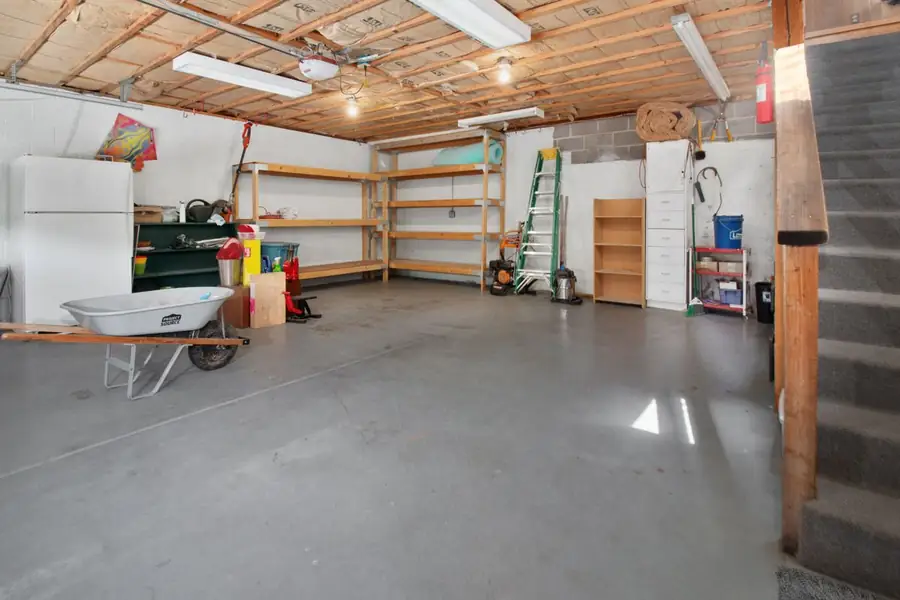
A garage floor coating in Bismarck is a resinous system installed over concrete that has been diamond ground to an open profile. Most residential jobs here are a flake broadcast build: an epoxy base coat, vinyl chips broadcast to refusal or to a specified density, a scrape and vacuum, then a clear polyaspartic or urethane topcoat. Typical installed cost is roughly $6 to $12 per square foot for a flake system, or $10 to $16 for a full polyaspartic build.
The reason we lead with the drip zone rather than with colour options is that the drip zone is where every Bismarck garage floor coating either earns its money or fails. Everything below is about that band.
The Drip Zone: The Eight Feet That Decide the Job
NDDOT treats North Dakota highways with straight salt, a salt and sand mix, and a liquid brine cut with sugar beet product that works well below zero. A vehicle driven through Bismarck in January is carrying that mixture in the wheel wells and on the underbody, and it drops most of it in the first eight to ten feet after the overhead door.
That gives you a strip of concrete that is wet with chloride solution, freezes when the garage cools overnight, and thaws again the next day. Chlorides increase both the number and the severity of those surface freeze-thaw events. On bare concrete the result is scaling, the loss of the thin finished top layer, which progresses to spalling with exposed aggregate. It is why homeowners describe the failure as showing up in a band rather than across the whole floor.
A continuous coating removes the pore structure the brine needs. But only if the film is bonded and continuous, including at the door threshold. A coating that stops short of the threshold or dies into a raw edge gives brine a way in behind the film, and then you have moisture trapped under a coating instead of on top of concrete. We terminate into a saw cut or coved edge at the door line for exactly this reason.
Choosing Sheen, Flake Density and Chip Size
Three decisions get made on almost every Bismarck garage quote, and most homeowners are never walked through them.
| Decision | Options | What it changes in a Bismarck garage |
|---|---|---|
| Sheen level | High gloss, satin, matte | Gloss shows every drop of melt water and every tyre mark; satin hides winter grime and is the practical default here. Matte hides the most but reads flat under a single garage light. |
| Flake density | Partial broadcast, full broadcast to refusal | A full broadcast hides repaired spalls and patched cracks completely. A partial broadcast is cheaper and lets the base colour show, but it will telegraph a repaired drip zone. |
| Chip size | 1/16 in, 1/8 in, 1/4 in | Bigger chips give more texture underfoot with wet boots and more visual depth; smaller chips give a finer, more uniform look and are easier to keep clean. |
Chip versus solid colour is worth its own thought. A solid colour garage floor looks sharp on install day and shows every patch, every trowel mark and every future repair. On an older Bismarck slab that has already lost surface, a full chip broadcast is usually the honest recommendation. More on flake and metallic systems →
Heated, Unheated, Attached, Detached
Bismarck garages fall into three groups and the group decides the system as much as the budget does.
Attached and heated. Shares a wall with the house, often has a unit heater. These will normally hold a 50 F slab through an epoxy cure even in the cold season, so the full range of systems is open year round. This is most of the newer north Bismarck stock in Boulder Ridge, Eagle Crest and Clear Sky.
Attached and unheated. Warmer than outside, still not 50 F in January. Workable with temporary heat and a tented, monitored cure, or with polyaspartic. Worth being honest about rather than crossing your fingers on.
Detached shops and pole barns. These sit at ambient. Between roughly November 24 and March 4, when Bismarck average highs stay below 35 F, a standard epoxy build in an unheated detached building is not going to cure to spec. Either it is a polyaspartic job or it is a spring job. Shop and pole barn floors →
Before we coat anything
If the drip zone has already scaled, the repair comes first and it is priced separately. Loose material gets ground back to sound concrete, edges are cut square, and voids are filled before any resin goes down. Coating over a failing surface just moves the failure plane under the film. Concrete repair and surface prep →