Polyaspartic is aliphatic polyurea. It is produced by reacting an aliphatic polyisocyanate with a polyaspartic ester, which is a chemically slowed-down polyurea that gives an installer a usable working window instead of the seconds a straight spray polyurea allows. In practice that yields a floor coating which cures at low temperatures, returns to service in hours, and does not amber under UV.
None of that would matter much in a warm market. In Bismarck it is the difference between a floor you can have installed and one you have to wait until May for.
The Cure Problem, in Numbers
Epoxy cure is temperature-driven in a way most homeowners underestimate. Euclid Chemical, a major coatings manufacturer, publishes three facts worth quoting directly: epoxy coatings are best applied above 50 F; for every 18 F drop below 70 F the cure time doubles; and most epoxies, unless specifically formulated for cold weather, will never fully cure below 50 F. Their own worked example is an 8 hour cure at 70 F becoming roughly 18 hours at 50 F.
It is also the slab temperature that governs, not the air temperature. The industry practice is to take the reading with an infrared surface thermometer on the concrete, because a 4 inch slab sitting on ground that is frozen four feet deep runs colder than the air above it, sometimes considerably.
Now overlay Bismarck. The cold season runs about 3.4 months, roughly November 24 to March 4, with average daily highs below 35 F. January averages a high of 24 F and a low of 6 F. The frost-free window is about four and a half months, mid May to late September. An unheated garage slab in Bismarck is below the epoxy threshold for a third of the year, and marginal for weeks on either side of that.
If a coating never reaches full cure it never develops its designed physical properties. It stays softer, bonds worse, and fails early, usually at the tyres. That is not a theoretical risk in this market, it is the most common reason a previous coating is on the floor we are being asked to grind off.
Polyaspartic Versus Polyurea Versus Epoxy
| Property | Epoxy | Polyurea | Polyaspartic |
|---|---|---|---|
| Chemistry | Amine-cured epoxy resin | Isocyanate plus amine, very fast | Aliphatic polyurea from a polyaspartic ester |
| Application temp | Best above 50 F | Wide, but very short pot life | Wide, supplier windows go well below freezing |
| Working time | Generous, 30 to 60 min | Seconds to a minute, spray only | Roughly 20 to 40 min, roller or squeegee |
| Return to service | Foot next day, vehicles 5 to 7 days | Very fast | Foot same day, vehicles 24 to 48 hours |
| UV stability | Ambers over time | Aromatic grades amber | Aliphatic, does not amber |
| Typical role | Base and body coat | Industrial linings | Topcoat, or the whole build in cold weather |
The practical Bismarck answer for a heated attached garage in summer is a hybrid: epoxy base and body coat for the build and the flake bed, polyaspartic clear on top for UV stability and fast return to service. For an unheated detached shop, or for any job between late November and early March, we quote polyaspartic through the whole build.
How a Winter Polyaspartic Install Actually Runs in Bismarck
Slab temperature is measured, not assumed
Infrared reading across the floor before anything is opened, including the cold strip along the overhead door where the slab runs coldest.
Materials are conditioned
Resin and hardener are stored warm, in the 70 to 90 F range, and brought in at temperature. Cold material behaves differently in the pail and on the floor.
The space gets tempered and dried
Indirect heat plus air movement, held steady rather than blasted. The aim is a stable slab and a controlled dew point, not a hot room and a cold floor.
Sections are planned before mixing
Polyaspartic gives roughly 20 to 40 minutes. The floor is divided, the crew positions are set and the flake is staged before a single kit is opened.
Cure is monitored, not left
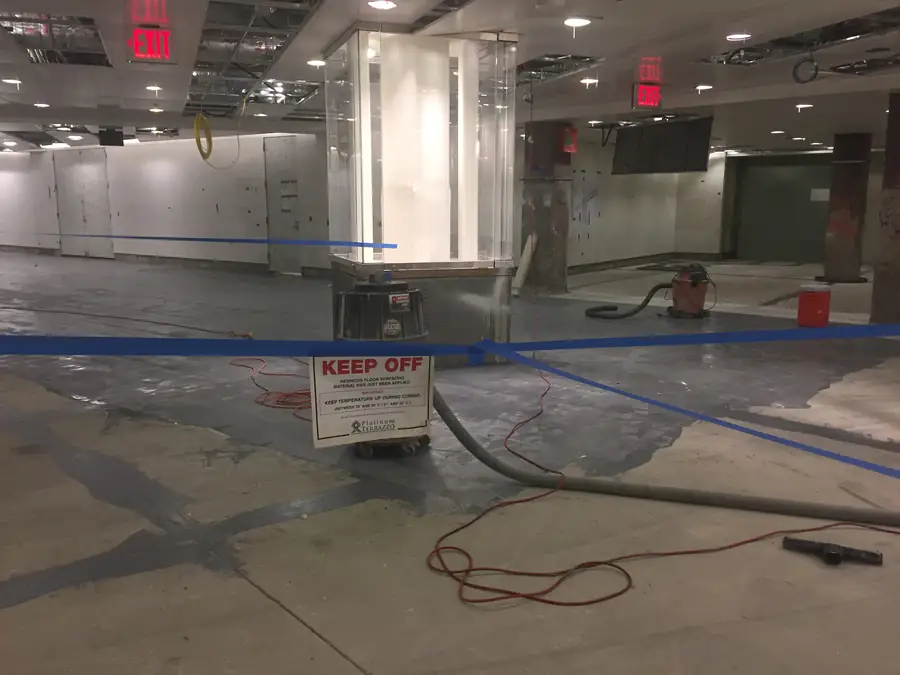
The heat stays on through cure. The reason coatings crews hang a keep-temperature-up placard on a fresh floor is that walking away and letting the space drop is how a winter install goes wrong.
The full seasonal picture, including which months we will and will not book which system, is in the Bismarck winter install guide.
Where polyaspartic earns its price here
- Detached garages and pole barns that sit at ambient all winter
- Any install booked between late November and early March
- Single-bay garages where five to seven days off the floor is not workable
- Overhead doors with glass panels, where an epoxy topcoat ambers in the sun strip
- Shops and service bays that cannot lose a week of production